Children across Eastern and Southern Africa continue to experience high levels of violence, abuse, neglect and exploitation. Preventing and responding to these risks requires a strong, well-planned and adequately resourced social service workforce that can deliver a continuum of child protection services.
UNICEF ESARO, working with UNICEF Kenya and UNICEF Zambia, commissioned Cornerstone Economic Research, in partnership with Maestral International, to develop and test a methodology for building an investment case for strengthening the social service workforce for child protection. The methodology was piloted in Kenya and Zambia and is intended to support governments and partners to make a stronger evidence-based case for increased investment in the recruitment, deployment, retention and professional development of the workforce.
The work responds to a critical challenge across the region: social service workforces remain understaffed, underfunded and undervalued, limiting the ability of child protection systems to prevent and respond effectively to violence, abuse, neglect, exploitation and harmful practices. The publications highlight that, on average, there are 58 social service workers for every 100,000 children in Eastern and Southern Africa, with significant variation between countries and depending on how the workforce is defined.
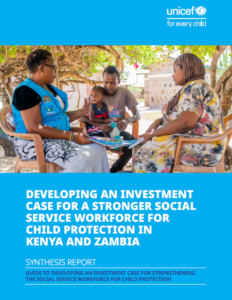
The Synthesis Report provides practical guidance on how to develop an investment case for strengthening the social service workforce for child protection. It sets out the key elements of an investment case, including describing the child protection problem, mapping the social service workforce, analysing current budget allocations, estimating the cost of inaction, developing solution scenarios, and costing proposed interventions. It also draws together lessons from the Kenya and Zambia pilots, including the use of workforce ratios, the development of the Multivariable Index of the Demand for Social Services, and approaches to estimating the economic and social costs of underinvestment.
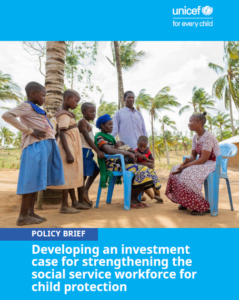
The accompanying Policy Brief distils the main lessons from the Kenya and Zambia case studies into an accessible advocacy product. It explains why investment cases are important, how they can be used to influence national budget priorities, and what kinds of evidence are needed to make a persuasive case for strengthening the social service workforce. The brief highlights that investment in the workforce is not only a moral imperative, but also a sound economic and social investment that can generate benefits for children, families, government and society.
Together, the two publications provide a practical resource for governments, UNICEF country offices, development partners and civil society organisations seeking to strengthen child protection systems through more credible, costed and evidence-based workforce planning.
The publications are now available (click on the picture to download the report):