

Early Childhood Development (ECD) is an investment in the future prosperity of societies. The evidence is overwhelming that the earliest years of life lay the foundation for health, learning, productivity, and resilience across the life course. When children are denied nurturing care, proper nutrition, early learning opportunities, and protection from adversity, the effects are profound, long-lasting and felt by children and their families, communities, and nations as a whole.
Recognising this urgency, UNICEF Pacific and Cornerstone Economic Research have partnered with the governments of Fiji and Samoa to conduct an ambitious study: Assessing the Cost of Inaction in Early Childhood Development. This project aims to quantify the economic and social losses that occur when ECD services are not provided at required quality and scale, while at the same time developing a clear, evidence-based investment case for expanding and improving services that give every child the best possible start in life.
Why This Project Matters
The 2030 Agenda for Sustainable Development calls on nations to “leave no one behind.” For Pacific Island countries, ensuring that young children thrive is central to this promise, yet the coverage of vital interventions does not match the commitments made, such as the Pasifika Call to Action on ECD.
According to the World Bank’s Human Capital Index, children born in Fiji today will achieve just 50.9% of their potential by age 18, while children in Samoa will achieve 54.8%. In other words, half of the future workforce potential is lost before adulthood—much of it due to poor conditions in early childhood. Such underdevelopment translates into lower educational attainment, poorer health, reduced productivity, and lower national income. In the long run, countries lose not only the opportunity for stronger, more equitable growth but also bear the heavy costs of higher health expenditures, social vulnerability, and intergenerational poverty.
Project Objectives
The project aims to make the investment case for increased spending on ECD services by exploring the following issues:
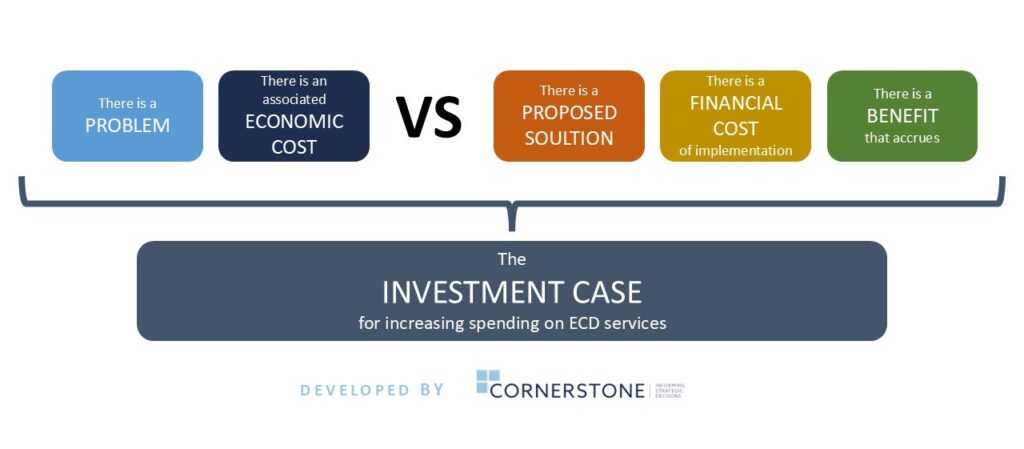
The project has a clear and ambitious set of objectives:
- Identify the problem – We begin by examining the current state of early childhood development in Fiji and Samoa. This includes reviewing how many children are developmentally on track, identifying which groups are most affected by deficits, and mapping existing coverage of essential ECD services.
- Put an economic value to the cost of the problem – Using economic modelling and statistical analyses, we will estimate the long-term costs associated with inadequate ECD. This includes reduced productivity, diminished lifetime earnings, increased health costs, and the broader social costs of reduced human capital.
- Propose High-Impact Interventions – Building on international evidence and local consultations, the project will propose solutions in the form of high impact interventions that can generate the biggest improvements in child development outcomes in the specific context of each country.
- Estimate the financial cost of the solution – For each intervention, we calculate the direct financial cost of implementing the intervention of suitable quality and at a scale large enough to make a real impact. The costing is practical, structured around how each government would implement the interventions at scale so that the results can easily be integrated into budget bids and funding proposals, as well as implementation plans.
- Approximate the economic returns that accrue from the interventions – Finally, we compare the long-term economic benefits of implementing interventions against the scenario of doing nothing. We are confident that will show clearly that the costs of inaction far outweigh the financial outlays required to expand ECD services.
How We Do the Work
Our approach is grounded in two well-established frameworks: UNICEF’s Nurturing Care Framework, which emphasizes the importance of health, nutrition, responsive caregiving, safety, and early learning, and human capital theory, which demonstrates how early investments yield long-term economic and social returns. By combining these perspectives, we link children’s developmental outcomes directly to future national prosperity.
The work begins with rigorous data analysis, using nationally representative surveys such as the 2021 Fiji MICS and the 2019–20 Samoa DHS-MICS, supplemented by other datasets where necessary. Through econometric modelling, the team estimates how poor early childhood outcomes affect later life trajectories in terms of education, health, and productivity. This evidence base makes it possible to put a monetary value on the consequences of underinvestment in ECD.
At the same time, practical costing tools are developed. These models calculate the resources required for staff, training, materials, and oversight to deliver interventions at scale. They are designed to reflect how these countries implement these interventions, and the variables and parameters can easily be adapted to test the feasibility of alternative implementation scenarios and time horizons of investment. Engagement with key stakeholders, especially the relevant ministries, ensures that proposed interventions are relevant to local contexts, realistic in their design, and aligned with policy processes.
Finally, the study models different scenarios of investment and compares them with the likely outcomes if no action is taken. This “cost of inaction” analysis demonstrates the profound economic and social losses that accumulate when children are denied essential early development services. In doing so, the project not only highlights the urgency of investment but also equips governments with evidence-based tools to make informed choices about how to allocate resources for maximum impact.
The Bigger Picture
Our aim is to influence policy, mobilise resources, and strengthen accountability for children in Fiji, Samoa, and the wider Pacific region. By showing governments and development partners the real costs of inaction, alongside the tangible benefits of investing in interventions that are proven to be effective, provides a powerful case for scaling up ECD interventions.
The project seeks to ensure that every child, can grow up healthy, nurtured, safe, and ready to learn. This means stronger families, more resilient communities, and nations that can unlock their full human capital potential.
Moving Forward
Through this work, Fiji and Samoa will have a clearer picture of the heavy price of underinvestment and a clear sense of the scale of resources required to prevent the losses. The findings will contribute to broader regional discussions among the Pacific Regional Council for Early Childhood Development (PRC4ECD), helping to shape shared strategies for the future.
The story of early childhood development is the story of a nation’s future. Inaction is costly, robbing children of potential and societies of prosperity. But the right actions are transformative. By investing in proven, high-impact interventions today, Fiji and Samoa can ensure that every child has the chance not just to survive but to thrive.